


If every order goes through an app, you are renting the customer relationship.
GrabFood and Foodpanda can help a restaurant get discovered, and they make ordering easy for customers who already use those apps. That does not mean they should be the only path to a sale.
Restaurant local SEO gives you a second path. It helps nearby diners find you on Google, Google Maps, and local search. A direct order page turns that traffic into calls, pickup orders, loyalty signups, and repeat customers.
The goal is not to remove GrabFood or Foodpanda. The goal is to stop making them the only way customers can order from you.
I have spent the last several years helping restaurants in the Philippines untangle this exact problem. Most do not have a delivery-app problem. They have a missing-owned-channel problem.
The fix is rarely a bigger website. It is a clearer ordering path: one page, real menu photos, real proof, real buttons, real tracking. The delivery apps stay. They just stop being the whole system.
My take: The strongest restaurant local SEO strategy connects Google visibility, a direct order page, delivery app links, and tracking. That gives customers choice while giving the restaurant more control.
Why delivery apps are useful, but risky as your only ordering system
Delivery apps solve a real problem. They help customers find food fast, reduce friction, and place restaurants where people already browse. They are part of a broader digital shift in the food industry that local owners cannot ignore. GrabFood Philippines builds its service around exactly that: fast restaurant delivery and takeout.
That discovery layer has real value. The risk starts when the app becomes the whole system.
If every order lives inside a third-party app, the restaurant may lose three things:
- Margin
- Customer data
- Repeat-order control
That matters because the second order is usually more valuable than the first.
A first-time customer may discover you on GrabFood or Foodpanda, and that is fine. But when that customer orders again next week, you want a way to bring them back through your own path: a direct order page, a phone order button, a pickup link, or a loyalty signup.
That path does not need to replace delivery apps. It needs to sit beside them.
Moneymax reports foodpanda merchant fees in the Philippines at roughly 25% to 30% per order, and GrabFood at roughly 10% to 25% per order. Rates can change and should be verified before quoting them in sales material.
The business point holds either way. If a restaurant depends only on app orders, it depends on someone else’s platform for demand, data, and repeat sales.
My take: Delivery apps are useful for restaurant discovery, but they should not be the only ordering system. A restaurant needs an owned page where customers can view the menu, choose an ordering path, join a list, and return without depending on a third-party app every time.
What restaurant local SEO has to do with direct orders
Restaurant local SEO is not only about ranking. It is about what happens after someone finds you.
A hungry customer may search:
- Pizza near me
- Best biryani in Cainta
- Deep dish pizza Davao
- Restaurant near me open now
- Filipino restaurant Antipolo
If your restaurant appears, the next click decides what happens. When that click sends people only to Facebook, a delivery app, or an outdated PDF menu, you lose control of the journey.
A direct order page gives Google and diners a better destination. It can show your menu, bestsellers, reviews, hours, map, pickup details, and ordering options in one place.
That is where local SEO for restaurants becomes commercial. You are not only chasing visibility. You are turning local search intent into a measurable action.
A strong Google Business Profile helps people find you. A strong direct order page helps them choose you. Together, they bridge search and sales.
My take: Restaurant local SEO helps a restaurant show up when nearby customers are ready to eat. A direct order page turns that visibility into action by giving customers the menu, proof, ordering options, location details, and a repeat-customer path on one owned page.
The Direct Order page blueprint
A direct order landing page is not a full website. It is a focused page built around one job: help a hungry customer choose how to order from you.
This is the structure my team and I use at Bite Blueprint when we build direct order pages for restaurant clients.
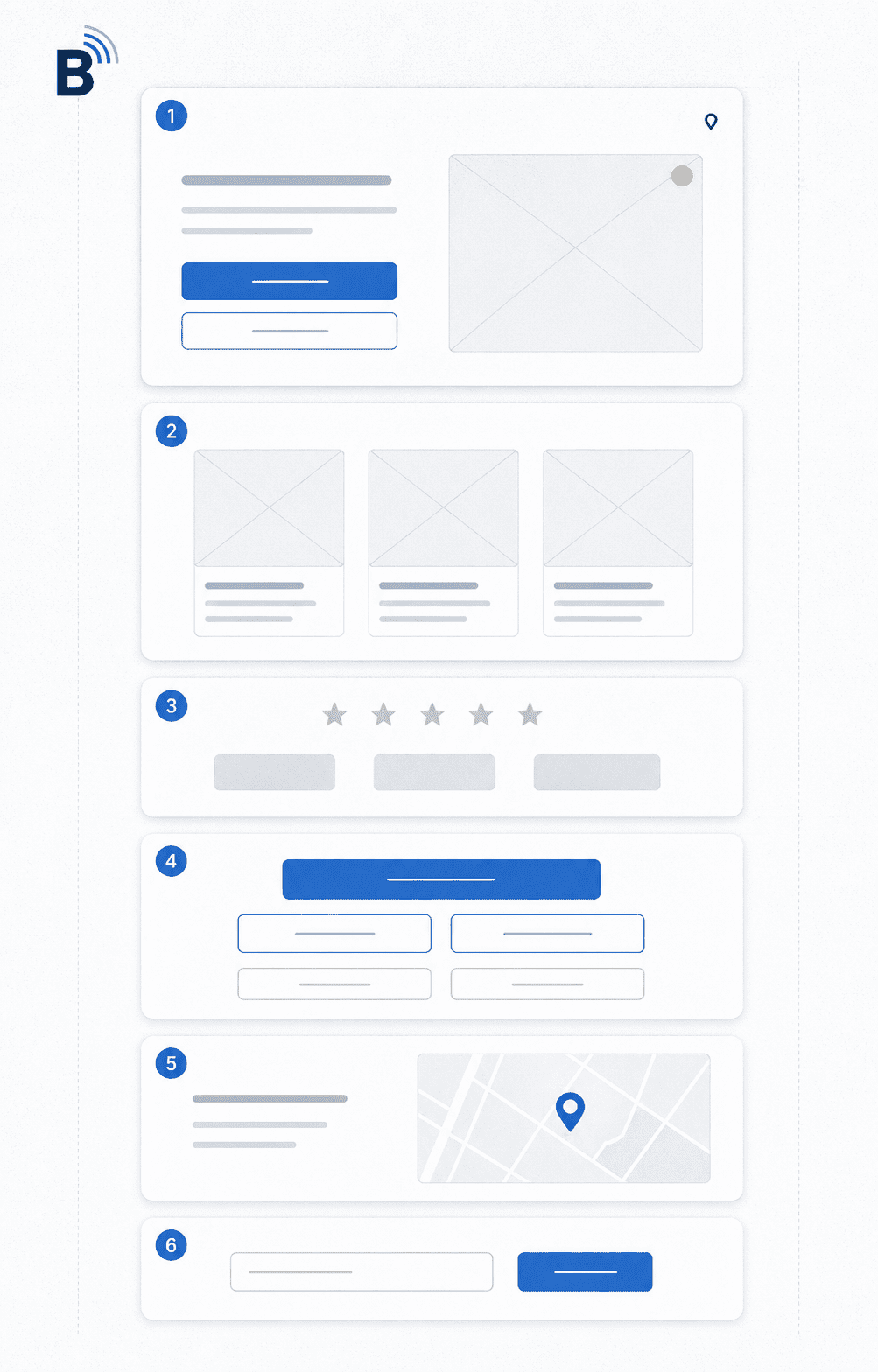
1. Hero section
The hero should answer four questions fast:
- What food do you sell?
- Where are you located?
- Why should customers trust you?
- How can they order now?
Use a clear formula:
[Signature food] in [City]. Order direct, pick up, or choose delivery.
Examples:
- Deep dish pizza in Davao. Order direct for pickup or delivery.
- Indian food in Cainta. View the menu and order your favorites.
- Antipolo cafe with a view. Call ahead or order for pickup.
Keep the main button simple. Use one of: Order Direct, Call to Order, View Menu, or Order for Pickup.
Do not place five equal buttons above the fold. If everything looks important, nothing reads as clear.
2. Menu highlights
Do not force customers to download a PDF. Show the items that make people hungry.
Start with:
- Bestsellers
- Signature dishes
- High-margin items
- Family bundles
- Pickup-friendly meals
- Limited-time offers
Use real photos where possible. A restaurant landing page template should never hide the food. The food is the product.
Keep menu cards simple. Each card can show:
- Dish name
- Short description
- Price or starting price
- Best use case
- Order button
Example:
Classic Deep Dish Pizza
Thick crust, house sauce, cheese pull, and dine-at-home comfort. Best for family pickup orders.
This section also supports local SEO. Use natural phrases like “deep dish pizza in Davao” or “Indian restaurant in Cainta” where they fit, but never force them into copy.
3. Trust section
A customer who has never ordered from you needs proof. Trust signals can include:
- Google reviews
- Foodpanda or GrabFood ratings
- Facebook follower count
- Years in business
- Customer photos
- Media mentions
- “First in Davao” or similar positioning
- Local awards or community proof
This is where a restaurant turns scattered social proof into one owned asset. If you have 73,000 Facebook followers, show it. If you have 2,900 reviews, use them. If your restaurant has a unique story, give it space.
Do not make customers hunt through Facebook, Yelp, or app profiles to understand why people already trust you.
4. Ordering path section
This section decides whether the page makes money. Make the customer’s options clear.
A simple order hierarchy works best:
- Order direct or call.
- View the menu.
- Use GrabFood or Foodpanda if preferred.
That order matters. The direct action should be the clearest path. App links can stay, but they should not overpower the page.
For example:
Prefer pickup? Call us directly for the fastest confirmation.
Prefer app delivery? You can still find us on GrabFood and Foodpanda.
That wording does not attack the platforms. It gives the customer choice, which is what most diners actually want.
5. Location and Google Maps section
Local customers need practical information. Do not bury the basics.
Include:
- Full address
- Opening hours
- Pickup instructions
- Parking notes
- Nearby landmarks
- Google Maps embed
- Contact number
- Service area if delivery is available
This supports Google Business Profile traffic. When someone clicks from Google Maps, they should land on a page that confirms they found the right place.
The page should answer:
- Are you open?
- Are you nearby?
- Can I order now?
- Can I pick up?
- Can I get delivery?
- Can I trust this restaurant?
That is restaurant local SEO with a commercial purpose, not just a ranking exercise.
6. Loyalty and repeat order section
This is the part most restaurant websites miss. The first order is not the finish line. The second order is where the owned system starts working.
Add a repeat-customer capture section. Useful options include:
- SMS signup
- Email signup
- Birthday offer
- Loyalty QR code
- Repeat customer discount
- “Join our list for weekly specials”
- Review request after pickup or delivery
This section protects the restaurant from starting from zero every week. It turns a one-time order into a relationship you actually own.
My take: A direct order landing page for restaurants should include a local hero section, menu highlights, trust signals, ordering paths, location details, and a repeat-customer capture system. The page should make direct ordering easy while still giving customers the option to use GrabFood or Foodpanda.
How to make GrabFood and Foodpanda work with your owned page
The smartest move is rarely to remove delivery apps. For most restaurants, the better move is to reposition them.
At Bite Blueprint, we treat GrabFood and Foodpanda as discovery channels, not as the whole ordering system.
Use GrabFood and Foodpanda as discovery channels. Use your direct order page as the repeat-order path.
The customer journey then looks like this:
| Customer moment | Best channel | Goal |
|---|---|---|
| First discovery | GrabFood, Foodpanda, Google, social media | Get seen |
| Trust check | Google Business Profile and direct order page | Build confidence |
| Order decision | Direct page, call, pickup, or app link | Make ordering easy |
| Repeat order | Email, SMS, QR code, Google search | Bring the customer back |

The page should not confuse customers with too many equal calls to action. Use a clear hierarchy.
Primary CTA:
- Order Direct
- Call to Order
- Order for Pickup
Secondary CTA:
- View Menu
- Get Directions
- See Bestsellers
Tertiary CTA:
- Order on GrabFood
- Order on Foodpanda
That way, you respect customer habits without giving away the whole journey.
Offline traffic can support the same system. Add QR codes to:
- Receipts
- Table tents
- Takeout bags
- Flyers
- Counter signs
- Menu inserts
The QR code should send customers to the direct order page, not only to a social profile. If they already bought from you once, do not make them rediscover you next time.
My take: Restaurants can use GrabFood and Foodpanda alongside a direct order page by treating the apps as discovery channels and the owned page as the repeat-order path. The page should make direct ordering the clearest action while keeping app links available for customers who prefer delivery platforms.
Tracking the system so it becomes measurable
A direct order page is not only a design asset. It is a measurement asset.
This is the part most restaurant owners skip, and it is the first thing we set up at Bite Blueprint before any traffic hits the page.
A restaurant website with online ordering only earns its place when you know which actions people actually take. At minimum, track:
- Direct order button clicks
- Call button clicks
- Menu clicks
- Google Maps clicks
- GrabFood clicks
- Foodpanda clicks
- Email or SMS signups
- QR code visits
- Form submissions
Here is a simple tracking map.
| Action | What to track | Why it matters |
|---|---|---|
| Order direct click | Button event | Shows demand for owned ordering |
| Call button | Call click or tracking number | Shows phone-order intent |
| Menu view | Menu click or scroll depth | Shows food interest |
| GrabFood or Foodpanda click | Outbound click | Shows app-dependent demand |
| Email or SMS signup | Form submission | Shows repeat-customer capture |
This is the part that changes the conversation. Without tracking, the owner only knows “we got some orders.” With tracking, the owner can see:
- Which channel sent the visitor
- Which button the visitor clicked
- Which menu items got attention
- Which app links still get used
- Which offers produced signups
That is how marketing stops being guesswork and starts behaving like a system.
My take: A restaurant should track direct order clicks, call button clicks, menu views, app-link clicks, and email or SMS signups. These events show whether local SEO is creating owned demand or only sending customers back to third-party apps.
A simple 7-day implementation plan
You do not need to rebuild the entire business in one week. Start with one page.
Day 1: Choose one direct ordering goal
Pick one goal first. Examples:
- More pickup orders
- More direct calls
- More catering inquiries
- More repeat customers
- More birthday offer signups
Do not build the page around every goal at once. The page works harder when its job is narrow.
Day 2: Build the page skeleton
Lay out the structure:
- Hero
- Menu highlights
- Trust signals
- Ordering options
- Location details
- Loyalty capture
- FAQ
This is your restaurant landing page template.
Day 3: Add menu highlights and proof
Add real food photos, your bestsellers, your strongest reviews, and your local story. If your food has a unique position, make it obvious in the first scroll.
Day 4: Add order buttons and app links
Add a direct order button, a call button, pickup instructions, and GrabFood or Foodpanda links if customers actively use them. Keep the hierarchy clear: direct first, app links second.
Day 5: Connect Google Business Profile
Update your Google Business Profile website link. Point it to the direct order page if this is the strongest conversion page on your site.
Check your hours, address, phone number, photos, and menu links. A local SEO campaign will struggle if those basics are wrong.
Day 6: Add tracking and QR codes
Set up tracking for your buttons and create QR codes for offline traffic. Use different QR links for:
- Receipts
- Table tents
- Flyers
- Counter signs
- Takeout packaging
That way you can see which offline assets actually send traffic.
Day 7: Test the full customer journey
Walk the journey like a customer. Search for your restaurant, click from Google, view the menu, tap the order button, tap the phone button, click the app links, and submit the signup form.
If anything feels confusing, fix it before promoting the page.
My take: A restaurant can start a direct order page in seven days by choosing one ordering goal, building the landing page, adding menu highlights, setting up ordering links, connecting Google Business Profile, adding tracking, and testing the journey from search to order.
When a restaurant should get help
Some restaurants can build this themselves. Others need help because the problem is not only a page. It is the whole system around the page.
You may need help if:
- You have no website.
- Your Google Business Profile is incomplete.
- Your menu exists only as a PDF or Facebook album.
- Your orders are split across apps, DMs, and phone calls.
- You do not know which channels create orders.
- You have no way to bring first-time customers back.
- You cannot track calls, clicks, form fills, or app-link traffic.
At that point, the issue is not design. It is marketing operations.
A direct order page should connect your website, Google profile, reviews, tracking, and follow-up. That is how a restaurant stops relying on random traffic and starts building an owned ordering path.
This is the kind of system my team and I build at Bite Blueprint for restaurant owners across the Philippines.
If you want the full system, download The One-System Marketing Blueprint. It shows how your website, Google profile, reviews, tracking, and follow-up can work as one connected engine.
If you only want to see what is missing from your current local visibility, start with the Free Local SEO Audit.
My take: A restaurant should get help when it depends on delivery apps, has no owned ordering page, lacks local SEO visibility, or cannot track which channels produce calls, clicks, and orders. At that point, the problem is no longer a page. It is a system gap.
FAQ
What is restaurant local SEO?
Restaurant local SEO helps a restaurant appear in nearby searches on Google, Google Maps, and local search results. It covers Google Business Profile optimization, location pages, reviews, menu visibility, photos, local keywords, and website structure.
The goal is simple: show up when nearby customers are ready to eat.
Do restaurants still need GrabFood and Foodpanda?
Many restaurants should still use GrabFood and Foodpanda. The problem is not using delivery apps. The problem is relying on them as the only customer path.
A better strategy uses delivery apps for discovery and an owned direct order page for repeat demand.
What is a direct order landing page?
A direct order landing page is a focused restaurant page built to help customers order. It includes the menu, trust signals, ordering options, location details, and repeat-customer capture.
It can link to app delivery, but it should also support direct calls, pickup, and owned follow-up.
Should a restaurant website link to delivery apps?
Yes, if customers use those apps. The page should still make the preferred direct action clear.
A restaurant can make “Order Direct” the primary button and keep GrabFood or Foodpanda as secondary options. That gives customers choice without making the restaurant fully dependent on app traffic.
What should restaurants track on a direct order page?
Restaurants should track direct order clicks, phone clicks, menu views, app-link clicks, QR code traffic, and signup form submissions. Those events show which channels create real demand.
They also reveal whether customers are moving toward owned ordering or staying inside third-party apps.